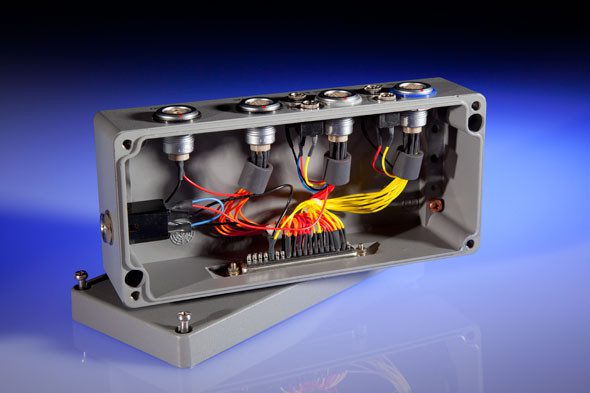
What Is Wire Harness Assembly?
Wire harness assembly is the process of organizing individual wires, connectors, terminals, and protective materials into a complete electrical assembly designed for a specific application. The finished harness routes electrical power and signals between components while protecting wiring from environmental and mechanical conditions encountered during operation.
Unlike loose wiring installed one conductor at a time, a completed wire harness is manufactured according to detailed engineering documentation. Each wire follows a predetermined path, uses specified connectors, and is secured using protective materials that help maintain organization and durability throughout the product’s lifecycle.
Depending on the application, a wire harness may contain only a few conductors or hundreds of individually terminated wires integrated into a single assembly. Each configuration is developed to meet the electrical, mechanical, and environmental requirements of the final product.
Common components found within a wire harness assembly include:
- Electrical wires and conductors
- Connectors
- Crimp terminals
- Protective sleeving
- Heat shrink tubing
- Cable ties and clamps
- Labels and identification markers
- Grommets and strain relief components
- Shielding materials where required
Together, these components create an organized electrical system that supports consistent installation, simplified maintenance, and dependable long-term operation.
Why Manufacturers Use Wire Harness Assemblies
As electronic products become more advanced, managing individual wires during production becomes increasingly difficult. Wire harness assemblies provide a structured solution that supports efficient manufacturing while reducing opportunities for installation errors.
Organizations commonly implement wire harness assemblies to:
- Simplify product assembly
- Improve wiring organization
- Reduce installation time
- Support manufacturing repeatability
- Protect wiring from vibration and abrasion
- Improve electrical reliability
- Simplify inspection and maintenance
- Support production scalability
For OEMs producing complex electronic systems, these advantages contribute to improved manufacturing efficiency and more consistent product quality.
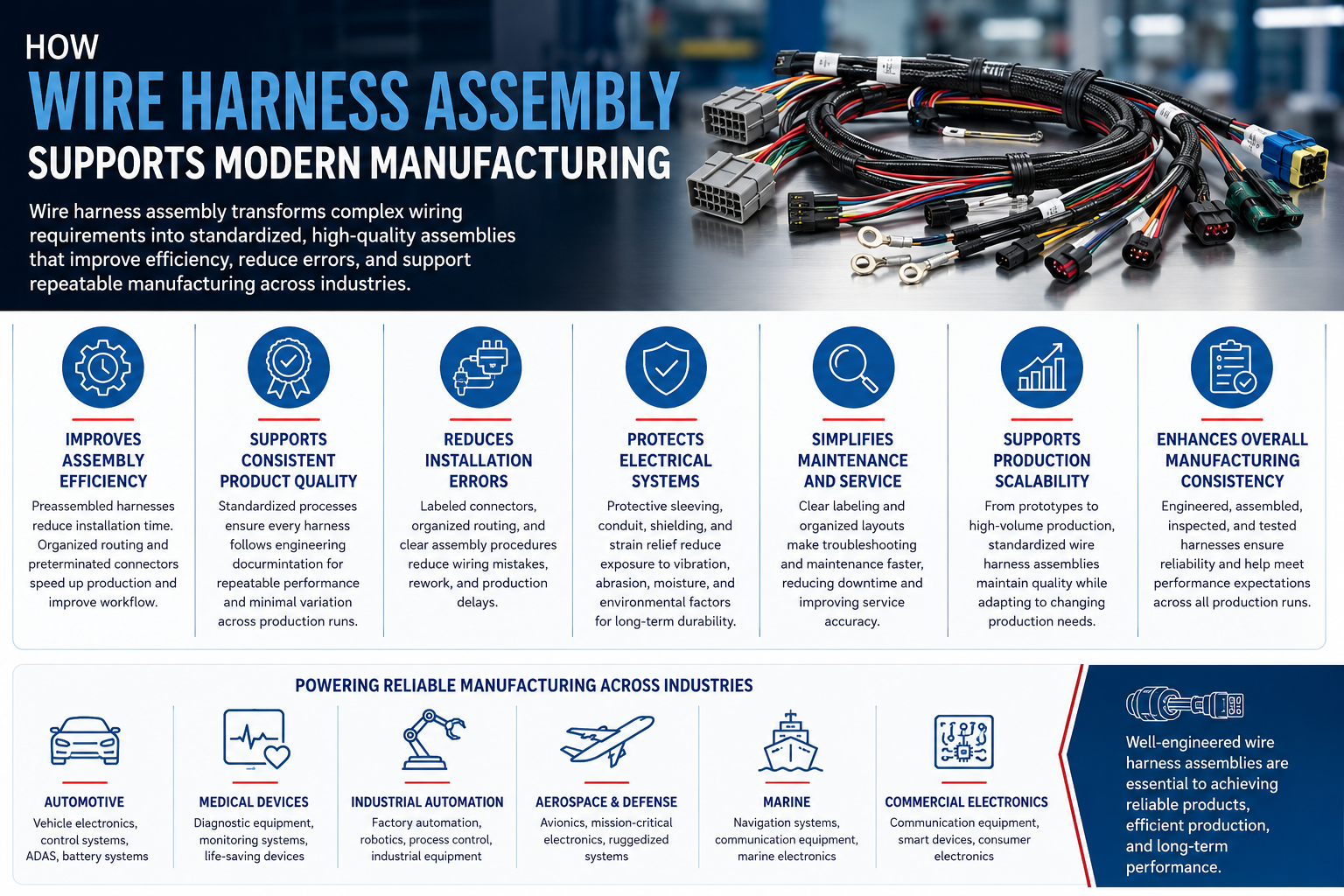
How Wire Harness Assembly Supports Modern Manufacturing
Manufacturing environments depend on consistency. Every production run must meet the same engineering specifications regardless of production volume. Wire harness assembly helps achieve this consistency by transforming complex wiring requirements into standardized assemblies that can be installed efficiently across multiple products.
Instead of routing dozens or hundreds of individual wires during final assembly, production teams install a completed harness that has already been engineered, assembled, inspected, and tested. This standardized approach reduces production variability while supporting repeatable manufacturing processes.
Improves Assembly Efficiency
Preassembled harnesses reduce the time required to install electrical systems during production. Organized routing and preterminated connectors allow manufacturing teams to complete installations more efficiently than manually connecting individual conductors.
Supports Consistent Product Quality
Standardized manufacturing processes help ensure that every harness adheres to the same engineering documentation, reducing variation across production batches and supporting repeatable product performance.
Reduces Installation Errors
Clearly identified connectors, organized routing paths, and documented assembly procedures reduce the likelihood of incorrect wiring during installation. Fewer installation errors can lead to less rework and more predictable production schedules.
Protects Electrical Systems
Protective materials such as sleeving, conduit, shielding, and strain relief components help reduce exposure to vibration, abrasion, moisture, and environmental contaminants. These protective features enhance durability throughout the product’s operating life.
Simplifies Maintenance and Service
Clearly labeled conductors and organized wiring layouts make troubleshooting, inspection, and future maintenance more efficient. Service technicians can identify circuits more quickly, reducing downtime during repairs or upgrades.
Supports Production Scalability
Whether manufacturing prototypes, low-volume assemblies, or large production runs, standardized wire harness assemblies help maintain consistent quality while supporting changing production requirements.
As electronic systems continue to increase in complexity, well-engineered wire harness assemblies remain an important part of achieving reliable manufacturing outcomes across industries ranging from automotive and medical devices to industrial automation, aerospace and defense, commercial electronics, and marine equipment.
Main Components of a Wire Harness Assembly
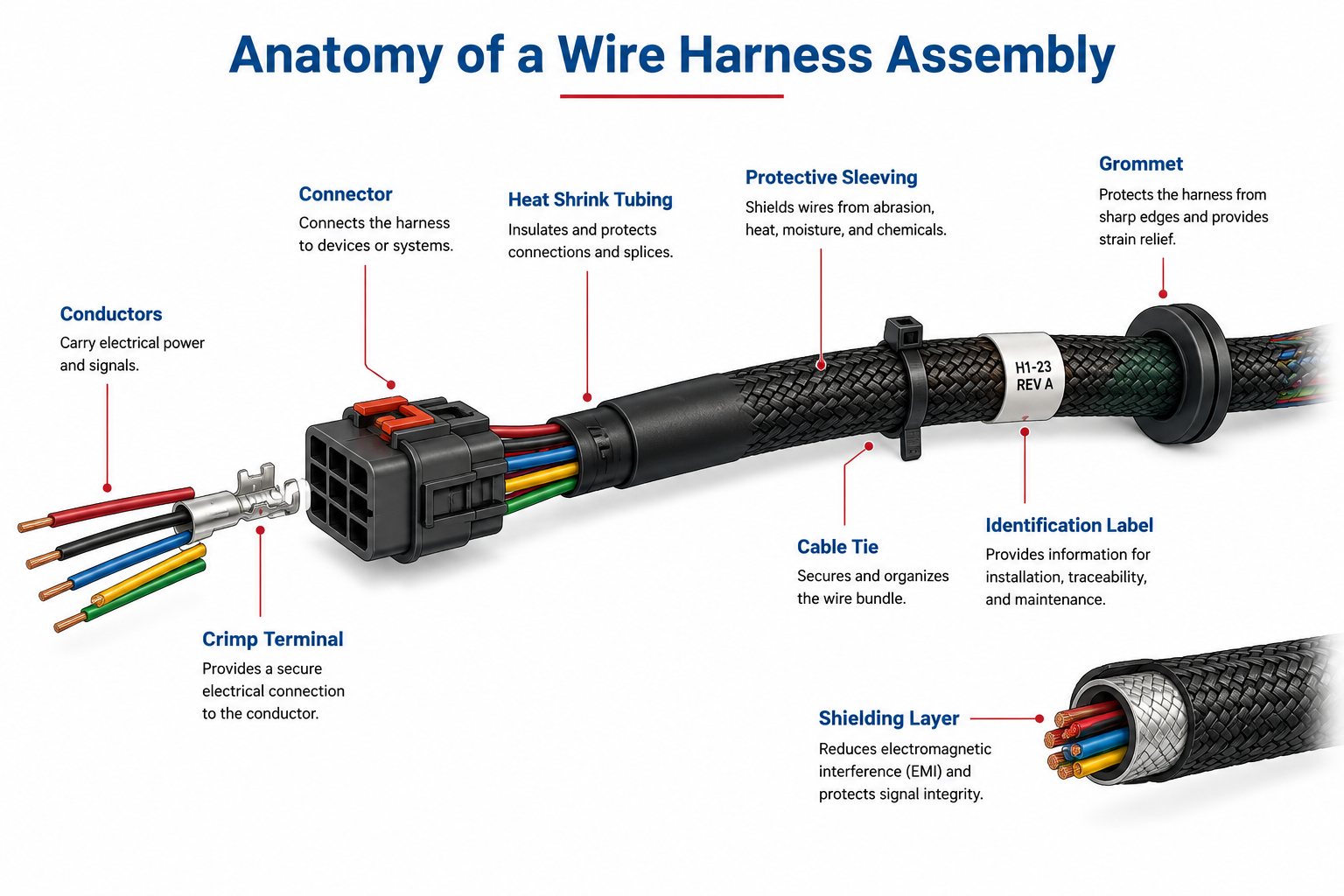
Every wire harness assembly is built from a combination of carefully selected components that work together to transmit electrical power and signals while protecting the wiring system throughout its operating life. Each component serves a specific purpose, contributing to electrical performance, mechanical durability, and manufacturing consistency.
The exact configuration varies by application, but most assemblies include the following elements.
Wires and Conductors
Conductors form the foundation of every wire harness. They carry electrical power, data, and control signals between connected devices.
Engineers select conductors based on several factors, including:
- Current carrying capacity
- Voltage requirements
- Operating temperature
- Flexibility
- Environmental conditions
- Installation space
Depending on the application, a harness may contain only a few conductors or several hundred organized into multiple branches.
Connectors
Connectors provide secure electrical interfaces between the wire harness and other system components.
Proper connector selection helps ensure:
- Reliable electrical contact
- Secure mechanical locking
- Simplified installation
- Faster maintenance
- Protection from vibration and moisture where required
Connector types vary significantly depending on industry requirements and operating environments.
Crimp Terminals
Terminals create the electrical connection between individual wires and connectors. Precision crimping is essential because poor crimps can increase resistance, reduce reliability, and contribute to premature electrical failures.
Consistent crimp quality supports:
- Stable electrical performance
- Strong mechanical retention
- Long-term durability
- Manufacturing repeatability
Protective Sleeving
Sleeving protects conductors from mechanical wear and environmental exposure.
Depending on application requirements, protective materials may help reduce exposure to:
- Abrasion
- Heat
- Moisture
- Chemicals
- Dust
- Vibration
Proper protection extends the service life of the completed harness while helping maintain electrical integrity.
Heat Shrink Tubing
Heat shrink tubing provides additional insulation and mechanical protection around wire terminations and splice locations.
It also helps:
- Secure wire bundles
- Improve strain relief
- Protect exposed connections
- Support environmental sealing where required
Cable Ties and Clamps
Cable ties and clamps organize conductors into structured bundles while maintaining routing throughout the assembly.
Organized routing helps:
- Reduce wire movement
- Improve installation consistency
- Minimize abrasion between conductors
- Simplify inspection and servicing
Labels and Identification Markers
Clear identification improves manufacturing accuracy and simplifies future maintenance.
Labels may identify:
- Wire numbers
- Connector locations
- Circuit information
- Assembly revisions
- Installation references
Accurate identification reduces assembly errors and supports documentation throughout production.
Grommets and Strain Relief Components
Where harnesses pass through enclosures or metal panels, grommets help prevent conductor damage caused by friction or sharp edges.
Strain relief components reduce mechanical stress on connectors and wire terminations by limiting excessive pulling or bending during installation and operation.
Shielding Materials
Certain applications require protection from electromagnetic interference (EMI) or radio frequency interference (RFI).
Shielding materials help preserve signal integrity in applications involving:
- Medical electronics
- Industrial automation
- Aerospace and defense systems
- Communication equipment
- Automotive electronic systems
Together, these components create a complete wire harness assembly that supports reliable electrical performance while simplifying manufacturing and long-term maintenance.
Step-by-Step Wire Harness Assembly Process
A reliable wire harness begins long before production starts. Every assembly follows a structured manufacturing process designed to maintain quality, consistency, and repeatability throughout each production run.
While individual manufacturing requirements vary by application, most wire harness manufacturers follow a similar workflow from engineering review through final inspection.
Engineering Review and Documentation
Manufacturing begins with a detailed review of engineering documentation.
Production teams verify:
- Drawings
- Bill of materials
- Wire schedules
- Connector specifications
- Routing requirements
- Testing criteria
This review helps identify potential manufacturing concerns before production begins while supporting efficient planning.
Material Selection
Once the documentation is approved, materials are selected in accordance with engineering requirements.
Typical materials include:
- Electrical wire
- Connectors
- Terminals
- Sleeving
- Heat shrink tubing
- Labels
- Protective accessories
Selecting compatible materials contributes to long-term assembly performance.
Wire Cutting and Preparation
Automated equipment cuts wires to precise lengths before preparing conductor ends for termination.
Preparation typically includes:
- Measuring
- Cutting
- Stripping insulation
- Marking identification
- Organizing wire groups
Accurate preparation reduces variation during later assembly stages.
Terminal Crimping
Prepared conductors receive crimp terminals using calibrated equipment.
Consistent crimp quality supports:
- Reliable electrical conductivity
- Mechanical strength
- Repeatable production quality
Many manufacturers perform regular crimp verification throughout production to maintain process consistency.
Connector Installation
After crimping, the terminals are inserted into the designated connector housings in accordance with the engineering documentation.
Each connector must match the required wire position, orientation, and locking mechanism before assembly proceeds.
Harness Routing and Bundling
Individual wires are routed according to the approved harness layout.
Routing determines:
- Branch locations
- Wire organization
- Bundle dimensions
- Bend radius
- Installation flexibility
Cable ties, sleeves, clamps, and protective materials secure the completed routing configuration.
Protective Covering Installation
Additional protective components are installed where required.
These may include:
- Sleeving
- Conduit
- Heat shrink tubing
- Protective boots
- Strain relief components
- Shielding materials
These protective features help prepare the harness for operating environments involving vibration, abrasion, moisture, or temperature variation.
Inspection and Electrical Testing
Every completed harness undergoes inspection before shipment.
Inspection activities commonly include:
- Visual inspection
- Continuity testing
- Pin verification
- Short-circuit testing
- Dimensional verification
- Documentation review
Testing confirms that each assembly meets the specified electrical and mechanical requirements before entering final production.
Packaging and Delivery
Following a successful inspection, completed harnesses are packaged to prevent damage during transportation and storage.
Proper packaging helps preserve connector integrity, routing organization, and protective materials until final installation at the customer’s facility.
Every production stage in the manufacturing process of wire harnesses, from engineering review and material preparation through crimping, routing, testing, and final inspection, contributes to the reliability of the finished assembly.
Types of Wire Harness Assemblies
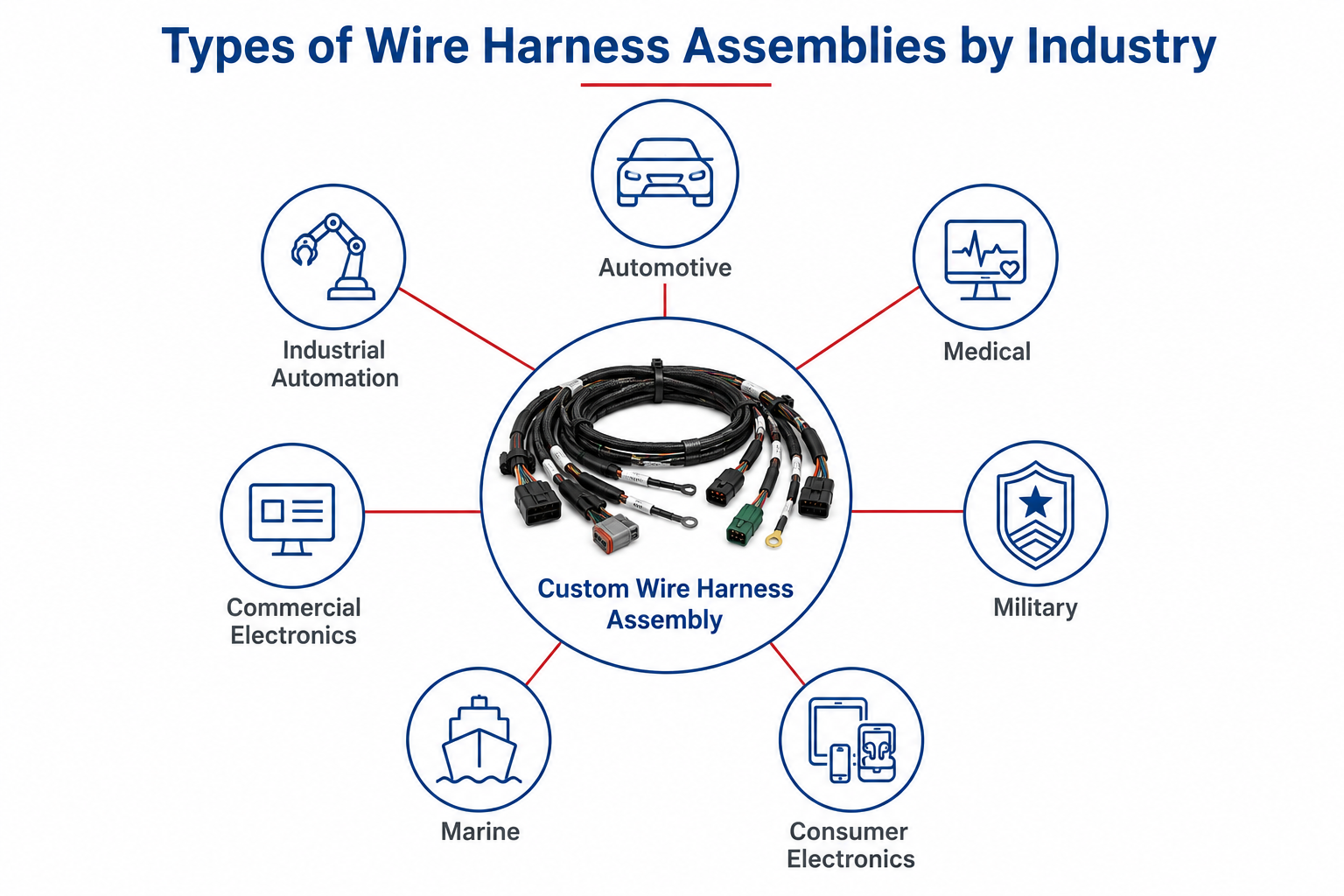
No single wire harness design fits every application. Different industries require unique configurations based on electrical requirements, operating conditions, available space, and regulatory expectations.
Wire harness manufacturers develop customized assemblies that align with the functional and environmental needs of each product.
Automotive Wire Harnesses
Modern vehicles contain extensive electrical systems supporting power distribution, lighting, sensors, safety systems, infotainment, battery management, and control modules.
Automotive harnesses are engineered to withstand:
- Continuous vibration
- Temperature variation
- Moisture
- Chemical exposure
- Tight installation spaces
Reliable routing and secure electrical connections contribute to consistent vehicle performance throughout the product lifecycle.
Industrial Wire Harnesses
Industrial automation systems rely on organized wiring to connect machinery, robotics, sensors, and process control equipment.
Industrial wire harness assemblies often prioritize:
- Durable construction
- Flexible routing
- Mechanical protection
- Simplified maintenance
- Long service life
These assemblies help support continuous manufacturing operations while reducing installation complexity.
Medical Wire Harnesses
Medical equipment requires carefully organized electrical assemblies that support reliable operation in diagnostic, monitoring, and healthcare environments.
Medical wire harnesses are commonly integrated into:
- Diagnostic equipment
- Imaging systems
- Patient monitoring devices
- Laboratory instruments
- Surgical equipment
Precision manufacturing and consistent assembly practices contribute to dependable product performance.
Military Wire Harnesses
Military applications frequently operate under demanding environmental conditions.
Wire harness assemblies for defense equipment may require protection against:
- Vibration
- Shock
- Extreme temperatures
- Moisture
- Dust
These assemblies support communication systems, navigation equipment, control electronics, and mission-critical applications where dependable electrical connectivity is essential. This enhances military capabilities through wire harness solutions for defense applications.
Commercial Electronics Wire Harnesses
Commercial electronic products often require compact wiring systems that support efficient assembly and dependable performance.
Applications include:
- Communication equipment
- Smart devices
- Control systems
- Electronic instrumentation
Organized harnesses simplify installation while improving manufacturing consistency across production volumes.
Marine Wire Harnesses
Marine environments present unique challenges due to moisture, salt exposure, vibration, and continuous movement.
Marine wire harness assemblies commonly incorporate protective materials that enhance durability and support reliable electrical performance in demanding operating conditions.
Consumer Electronics Wire Harnesses
Consumer electronic products continue to become smaller while incorporating more features.
Compact wire harness assemblies help manufacturers organize internal wiring, reduce assembly time, and improve consistency across high-volume production.
Different industries place different demands on electrical assemblies, making customization an important part of the manufacturing process. Selecting the appropriate harness design helps support both manufacturing efficiency and long-term product reliability.
Wire Harness Assembly vs Cable Assembly
Although the terms are sometimes used interchangeably, wire harness assembly and cable assembly serve different purposes. Understanding these differences helps engineering teams and procurement professionals select the appropriate solution for a particular application.
| Feature | Wire Harness Assembly | Cable Assembly |
|---|---|---|
| Primary Purpose | Organizes multiple individual wires into a structured assembly | Protects one or more conductors within a durable outer jacket |
| Construction | Bundled wires secured with ties, sleeves, clamps, and protective materials | Conductors enclosed inside a continuous protective sheath |
| Flexibility | Highly customizable with multiple branches and connector locations | Typically follows a single routing path |
| Protection | Individual protective components applied where required | Continuous jacket provides environmental protection |
| Typical Applications | Automotive, industrial automation, medical devices, commercial electronics, marine, aerospace and defense | Data transmission, power cables, communication systems, instrumentation |
| Installation | Simplifies routing through complex equipment | Simplifies installation where continuous cable protection is required |
| Maintenance | Individual branches are easier to identify and service | Outer jacket protects conductors but may require complete cable replacement if damaged |
Both wire and cable harness manufacturers play important roles in modern setups. The appropriate choice depends on the electrical design, environmental conditions, installation requirements, and overall product architecture. Many complex electronic products incorporate both wire harnesses and cable assemblies as part of the same integrated system.
Industries That Depend on Wire Harness Assembly
Nearly every modern electronic system depends on organized electrical connectivity to function reliably. As products become more advanced, wire harness assembly plays an increasingly important role in simplifying installation, protecting conductors, and supporting consistent manufacturing across diverse industries.
Different industries present unique operating environments, electrical requirements, and regulatory expectations. As a result, harnesses are engineered to address the specific demands of each application rather than using a one-size-fits-all design.
Automotive
Modern vehicles contain extensive electrical networks that connect sensors, lighting systems, control modules, battery management systems, infotainment equipment, and advanced driver assistance technologies.
Wire harness assemblies help support:
- Vehicle control systems
- Battery systems
- Sensor integration
- Interior electronics
- Lighting systems
- Infotainment equipment
Proper routing and secure electrical connections contribute to manufacturing consistency while supporting long-term vehicle reliability.
Aerospace and Defense
Electronic systems used in aerospace and defense applications often operate in demanding environments where reliability is essential.
Wire harness assemblies support applications including:
- Avionics
- Communication equipment
- Navigation systems
- Control electronics
- Mission-critical assemblies
- Ruggedized electronic systems
These assemblies are engineered to help withstand vibration, temperature variation, and other challenging operating conditions.
Medical Devices
Medical equipment relies on organized electrical systems to support accurate operation and dependable performance.
Common applications include:
- Diagnostic equipment
- Patient monitoring systems
- Medical imaging equipment
- Laboratory instruments
- Healthcare electronics
Carefully manufactured harness assemblies help support consistent electrical connectivity throughout the equipment lifecycle.
Industrial Automation
Manufacturing facilities depend on electrical systems that connect machines, robotics, sensors, programmable controllers, and process equipment.
Wire harness assemblies help simplify installation for:
- Factory automation
- Robotics
- Material handling systems
- Process control equipment
- Industrial machinery
Standardized assemblies also simplify maintenance and support efficient production operations.
Marine
Marine equipment operates in environments that expose electrical systems to moisture, vibration, salt, and changing temperatures.
Wire harness assemblies commonly support:
- Navigation systems
- Marine communication equipment
- Control systems
- Monitoring equipment
- Power distribution
Protective materials help improve durability under demanding environmental conditions.
Commercial Electronics
Commercial electronic products continue to increase in functionality while becoming smaller and more compact.
Applications include:
- Communication equipment
- Electronic instrumentation
- Building controls
- Commercial control panels
- Business electronics
Organized harness assemblies help reduce installation complexity while supporting consistent manufacturing.
Consumer Electronics
Consumer products frequently contain multiple interconnected electronic components within compact enclosures.
Wire harness assemblies support:
- Smart devices
- Connected appliances
- Electronic accessories
- Consumer communication devices
Compact harness designs help improve assembly efficiency while maintaining organized internal wiring.
Every industry presents unique electrical, environmental, and mechanical requirements, making application-specific design an important part of wire harness engineering. With the right design, wire harnesses become more feasible for use in various applications.
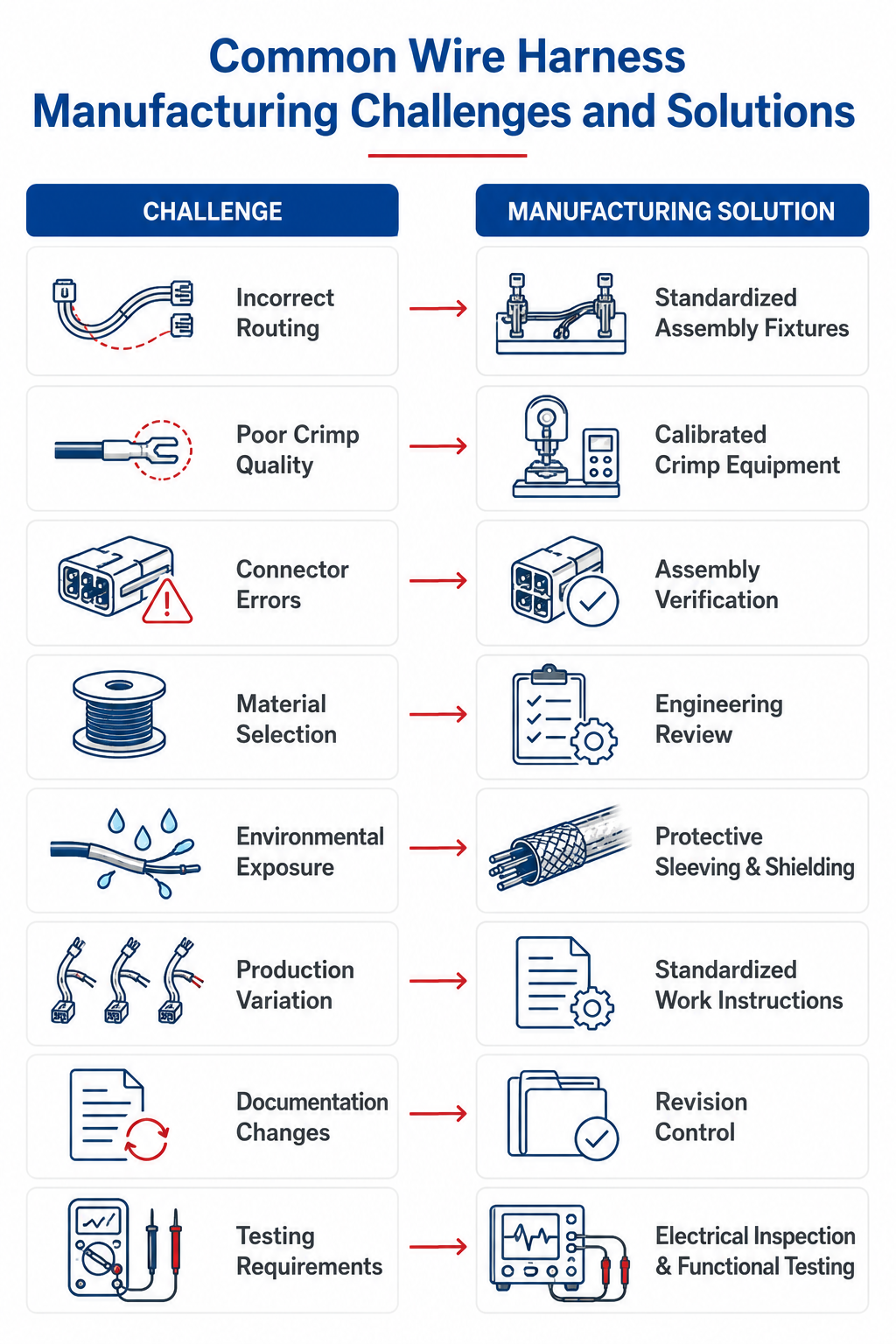
Common Manufacturing Challenges in Wire Harness Assembly
Even with well-documented engineering specifications, manufacturing complex wire harness assemblies presents several challenges. Small inconsistencies during production can affect installation efficiency, product quality, and long-term reliability.
Understanding these challenges allows engineering and manufacturing teams to implement processes that support consistent production outcomes.
Incorrect Wire Routing
Improper routing can place unnecessary stress on conductors, create interference with nearby components, or complicate installation.
Effective engineering documentation and assembly fixtures help maintain consistent routing throughout production.
Inconsistent Crimp Quality
Electrical connections depend on properly crimped terminals. Inconsistent crimping may affect conductivity or reduce mechanical strength.
Using calibrated equipment and performing routine inspections helps maintain repeatable crimp quality.
Connector Assembly Errors
Incorrect connector orientation or improper terminal placement can create installation issues and electrical failures.
Verification procedures and documented assembly instructions help reduce connector-related errors.
Material Selection Challenges
Different applications require different insulation materials, protective sleeving, connector types, and conductor specifications.
Selecting materials that match the operating environment helps support long-term durability and electrical performance.
Environmental Protection
Some applications expose wire harnesses to:
- Moisture
- Dust
- Chemicals
- High temperatures
- Continuous vibration
Appropriate protective components help reduce environmental exposure throughout the product lifecycle.
Production Variability
As production volumes increase, maintaining consistency becomes increasingly important.
Standardized work instructions, documented processes, and repeatable manufacturing methods help reduce variation between production runs.
Documentation Control
Engineering changes occur throughout product development.
Maintaining up-to-date documentation helps ensure that every production run adheres to the latest approved specifications and reduces assembly errors.
Testing and Inspection
Complex assemblies often contain numerous circuits that require verification before shipment.
Inspection activities help confirm:
- Electrical continuity
- Connector placement
- Wire identification
- Assembly dimensions
- Overall workmanship
Testing supports reliable production while reducing the likelihood of defects reaching final assembly.
Although these challenges vary by application, structured manufacturing processes help improve consistency while supporting dependable electrical performance across production volumes.
How to Evaluate Wire Harness Manufacturers
Selecting the right manufacturing partner involves more than comparing production capacity or pricing. Engineering capabilities, manufacturing consistency, quality processes, and long-term production support all influence supplier performance. Organizations beginning the evaluation process can also compare leading wire harness manufacturers in the USA before assessing which capabilities best align with specific production requirements.
For OEMs and procurement teams, evaluating potential wire harness suppliers against a defined set of criteria can help reduce production risks while supporting long-term manufacturing success.
Evaluate Engineering Support
Every successful wire harness project begins with careful planning. Manufacturers that provide engineering support can help identify potential manufacturing concerns before production starts.
Engineering capabilities may include:
- Design review
- Documentation review
- Design for manufacturability (DFM)
- Production planning
- Material recommendations
- Assembly optimization
Early collaboration can improve manufacturability while reducing unnecessary revisions later in production.
Review Manufacturing Capabilities
Different products require different production methods. Some applications involve prototype builds, while others require low- or high-volume manufacturing.
When evaluating wire harness manufacturers, consider whether they can support:
- Prototype production
- Low volume manufacturing
- High volume production
- Complex wire routing
- Multiple connector configurations
- Integrated cable and wire harness assemblies
Manufacturing flexibility helps support changing production requirements throughout a product’s lifecycle.
Understand Quality Processes
Quality should be integrated throughout manufacturing rather than limited to final inspection.
Organizations should evaluate whether a manufacturer follows documented quality practices such as:
- Incoming material verification
- In-process inspections
- Electrical testing
- Functional testing
- Visual inspection
- Production documentation
- Traceability
Consistent quality processes contribute to repeatable manufacturing outcomes across production runs.
Assess Supply Chain Management
Reliable production depends on more than assembly operations. Material availability, vendor coordination, and inventory planning all influence production schedules.
Manufacturers with established supply chain management capabilities can help support:
- Material sourcing
- Inventory management
- Procurement planning
- Production scheduling
- Supplier coordination
These processes contribute to more predictable manufacturing timelines.
Verify Industry Experience
Different industries present different manufacturing challenges.
Organizations should evaluate whether a supplier has experience supporting applications such as:
- Automotive
- Aerospace and defense
- Medical devices
- Industrial automation
- Marine
- Commercial electronics
Experience with similar applications often helps streamline production planning and documentation.
Review Testing Capabilities
Testing verifies that completed harnesses meet engineering specifications before shipment.
Testing capabilities may include:
- Continuity testing
- Pin verification
- Short-circuit testing
- Functional testing
- Visual inspection
Comprehensive testing helps reduce the likelihood of defects reaching final product assembly.
Consider Communication and Documentation
Successful manufacturing projects rely on accurate communication between engineering, procurement, and production teams.
Manufacturers should provide clear documentation for:
- Engineering revisions
- Production status
- Quality records
- Inspection results
- Manufacturing changes
Well-maintained documentation supports efficient collaboration throughout the production lifecycle.
Evaluate Scalability
Production requirements often change as products move from development into full manufacturing.
An effective manufacturing partner should be capable of supporting:
- Prototype development
- Pilot production
- Low volume manufacturing
- High volume production
Scalable manufacturing capabilities reduce the need to transition between suppliers as production grows.
Supporting Reliable Wire Harness Assembly Throughout Production
As electronic systems continue to become more sophisticated, organized electrical connectivity remains essential to manufacturing efficiency, product reliability, and long-term performance. A well-engineered wire harness assembly simplifies installation, protects critical electrical connections, supports maintenance, and improves consistency across prototype, low-volume, and high-volume production.
Selecting the right manufacturing partner involves evaluating engineering support, manufacturing capabilities, quality management, testing procedures, supply chain coordination, and production capacity. These factors help organizations build dependable electrical systems that perform consistently throughout the product lifecycle.
Star Engineering Inc. supports OEMs with custom cable and wire harness assembly solutions for automotive, aerospace and defense, medical, marine, commercial, and industrial applications. From engineering review and documentation through manufacturing, inspection, testing, and production support, the company helps organizations develop reliable electronic assemblies designed for consistent manufacturing outcomes. Learn more about Star Engineering Inc.’s wire harness assembly capabilities or contact the team to discuss upcoming manufacturing requirements.
Frequently Asked Questions
Wire harness assembly is the process of organizing wires, connectors, terminals, and protective components into a complete electrical assembly designed for a specific application. The finished harness simplifies installation while supporting reliable power and signal transmission.
A wire harness organizes multiple individual wires using connectors, protective sleeving, cable ties, and routing components. A cable assembly typically encloses one or more conductors within a continuous protective outer jacket. Many electronic systems incorporate both solutions depending on the application.
Quality control helps verify that each assembly meets engineering specifications before installation. Inspection, electrical testing, documentation, and traceability contribute to manufacturing consistency while reducing the likelihood of defects.
Quality control helps verify that each assembly meets engineering specifications before installation. Inspection, electrical testing, documentation, and traceability contribute to manufacturing consistency while reducing the likelihood of defects.
Important considerations include engineering support, manufacturing capabilities, quality management, testing procedures, supply chain coordination, documentation practices, production scalability, and experience serving similar industries.
Custom wire harness designs simplify installation, improve wiring organization, reduce assembly errors, support maintenance, and help manufacturers achieve repeatable production quality across multiple product configurations.
Yes. Many manufacturers support prototype development, low-volume production, and high-volume manufacturing through standardized processes that maintain consistency across all production stages.
Electrical testing verifies continuity, connector placement, circuit integrity, and overall assembly accuracy. These inspections help confirm that completed wire harnesses meet engineering requirements before entering final product assembly.